


Introduction
With the rapid upgrade of commercial display technology, SMD and COB have become the two mainstream packaging technologies in the LED industry. Many buyers cannot tell their differences, resulting in incorrect product selection.
We analyze the structural differences, performance advantages, durability, and applicable scenarios of SMD and COB LED screens to help global clients select the most suitable solution.
1. Technical Principle Difference
SMD (Surface Mount Device)
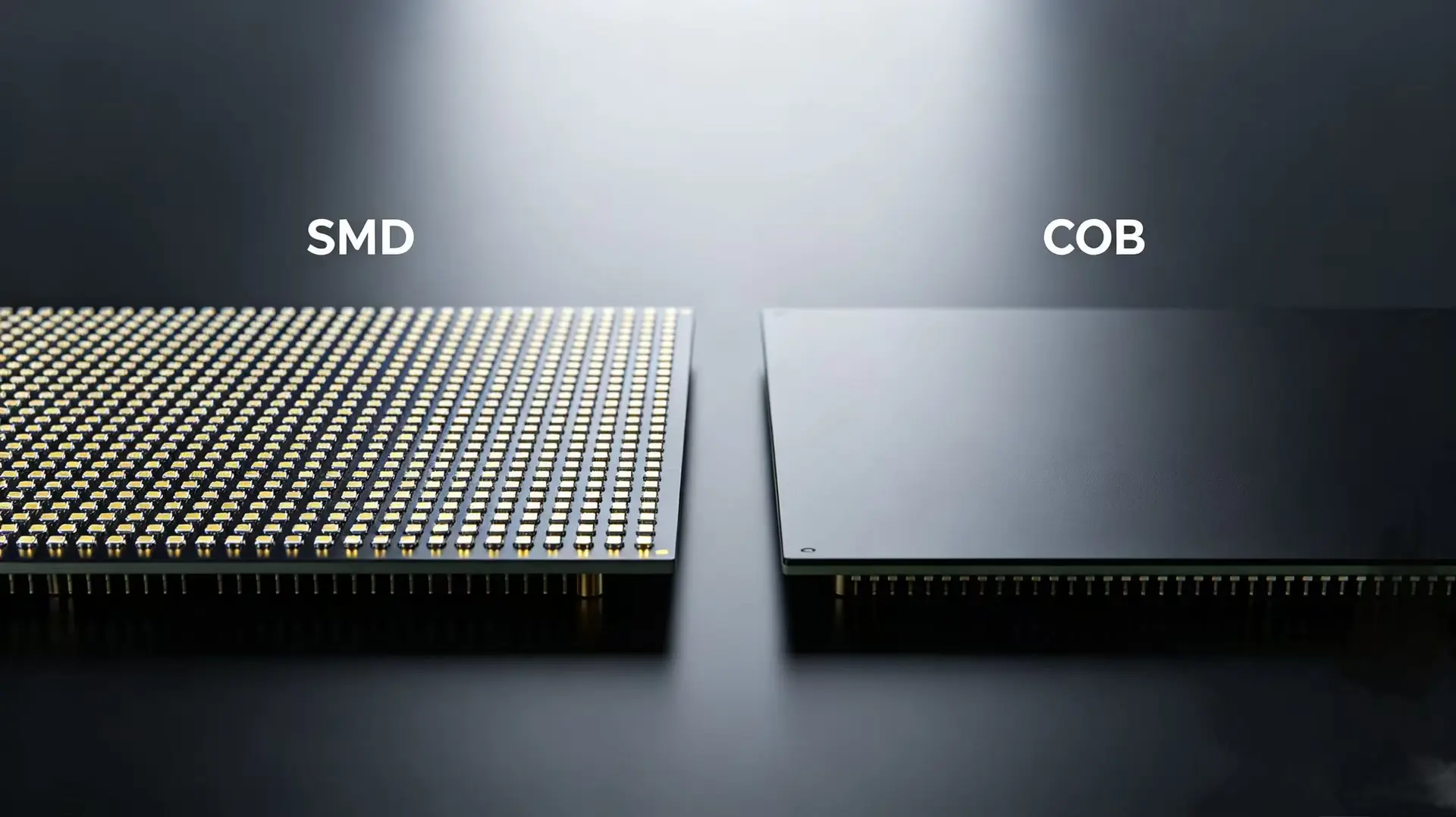
Traditional surface mounting technology independently pastes RGB lamp beads on the PCB board. It features mature technology, stable mass production, and cost advantages, occupying most of the mid-range LED display market.
COB (Chip on Board)
Advanced packaging technology directly attaches LED chips to the PCB board and covers the surface with an insulating glue layer. The overall surface is seamless, anti-collision, dust-proof, and highly integrated.
2. Surface Flatness & Visual Effect
- SMD: Slightly granular surface, visible lamp bead gaps under close viewing
- COB: Completely seamless surface, ultra-high flatness, more delicate color performance, no grainy feeling
COB technology significantly improves contrast and black level performance, making dark scenes purer and videos more layered.
3. Durability & Anti-damage Performance
- SMD: Lamp beads are exposed externally, easy to be damaged by collision, dust accumulation, and water vapor penetration
- COB: Fully covered protective glue layer, anti-collision, anti-pressure, dust-proof, moisture-proof, and scratch-resistant
COB screens greatly reduce after-sales maintenance rate, especially suitable for high-traffic public spaces and long-term commercial operation.
4. Viewing Angle Performance
COB packaging optimizes the light-emitting angle design, achieving a 160° ultra-wide viewing angle with uniform color at all angles, no color deviation, and no dark corners. Traditional SMD screens have slight color attenuation at edge viewing angles.
5. Applicable Scenarios
SMD Application
Rental events, stage screens, conventional indoor and outdoor advertising screens, cost-sensitive standard projects.
COB Application
High-end retail stores, museum exhibition screens, high-end hotel lobby displays, fine-pitch conference screens, and high requirement commercial display projects.
Conclusion
SMD is cost-effective and mature for standard projects, while COB represents the high-end development direction of the LED industry with better flatness, durability, and visual experience.
We support both SMD and COB customized solutions to match different budget and project grade requirements.